Toward a European Energy Union
2026-06-18 IMISpeech by Kristalina Georgieva, IMF Managing Director, at the Eurogroup in Inclusive Format, June 11, 2026.
Thank you, Kyriákos, for your invitation to address ministers today on energy security.
Three months into the Middle East war, global oil supply remains down by some 13 percent relative to pre-war levels, and global LNG supply by some 20 percent.
The impact of this war is very asymmetric, depending on whether countries are taking direct hits, who is a net importer or exporter of oil and gas, and who has policy space.
Low-income countries and emerging markets reliant on imports are hit especially hard by the higher fuel and fertilizer prices.
So let me start with an appeal. Europe: standing in solidarity with the broader international community, please step up to support the hardest hit and least fortunate countries, wherever they may be, including by facilitating their access to fertilizers and critical refined products such as diesel.
And as for this continent, I want to start with a big thumbs-up: congratulations to Europe for the visionary policies you have pursued over the years—your steadfast emphasis on the energy transition.
These policies have cut the energy intensity of EU output by more than 40 percent over 30 years while also cutting oil dependence. They leave Europe far less exposed than might otherwise have been the case.
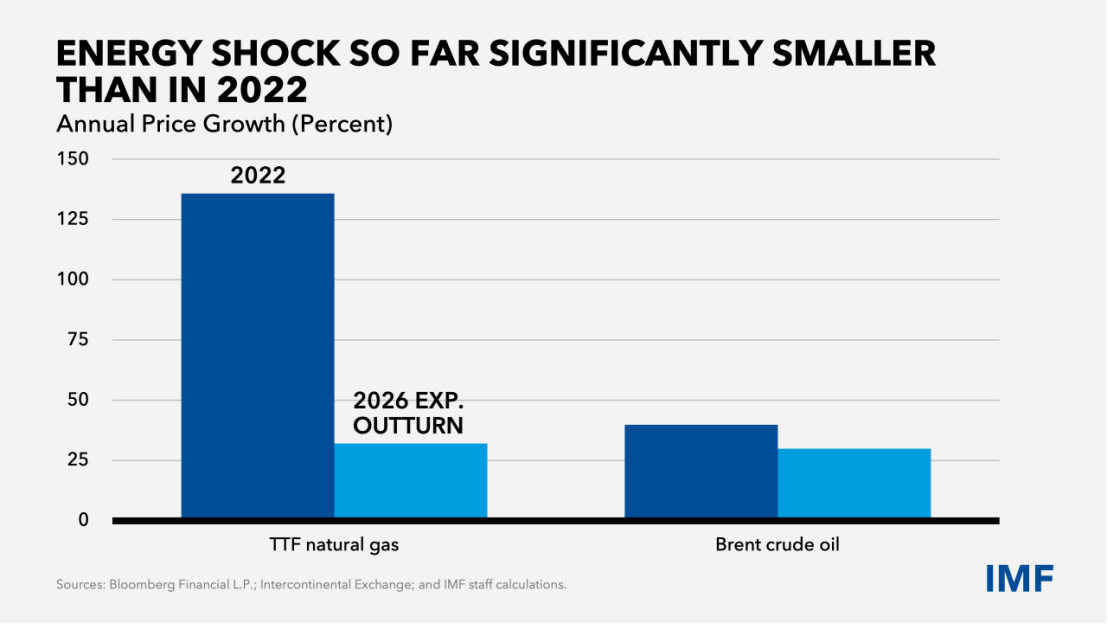
Those of you who are veterans of 2022 know that today’s gas price shock is much smaller than what Europe saw last time around. But for oil, the shock is almost as large. So far, the main effects are in transport costs. Over time, however, reserves could deplete and, yes, winter will come, adding heating costs to the mix.
Some things don’t change, of course, and political economy is one of them: governments once more feel the pressure to provide broad-based fiscal support.
Most of your new measures are temporary—bravo—even if sunset clauses may not be watertight. And well done also for keeping the fiscal costs much lower than in 2022—very important!
That said, I regret that most of the new measures are again untargeted, muting the price signal. The result? Less energy savings—with global spillovers and damaging impacts for poorer nations—as well as reduced fiscal efficiency.
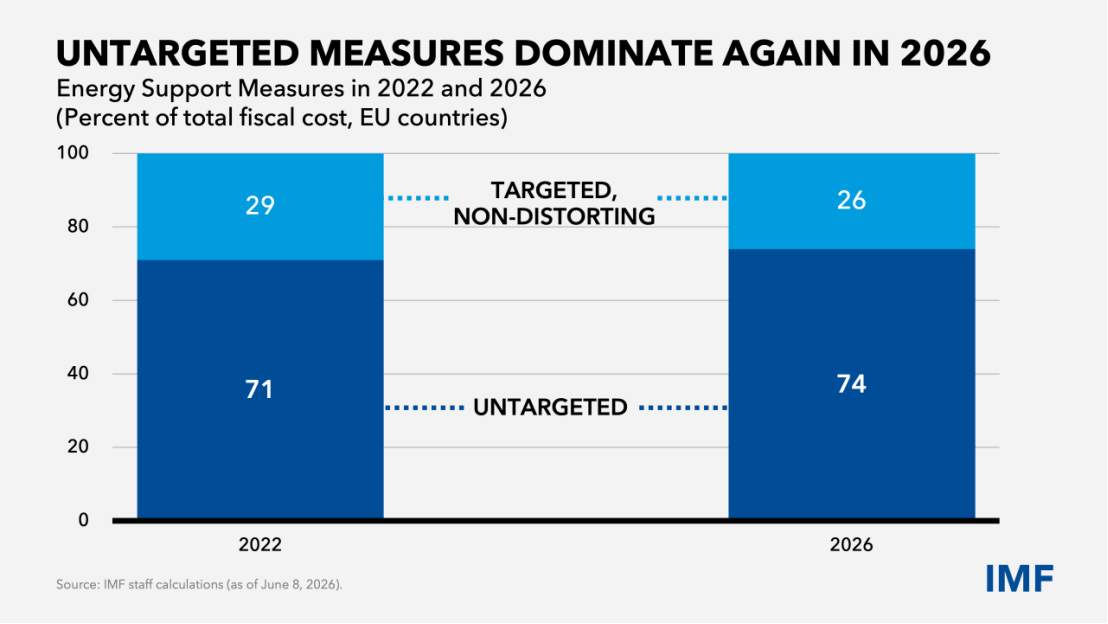
In response to the 2022 shock, over two-thirds of EU support was poorly targeted or price-suppressing. A better-targeted plan—fully protecting the poorest 40 percent of households but stopping there—would have saved almost two-thirds of the fiscal cost. Instead, the wealthiest quintile received nearly three times more than the poorest.
Let us learn the lessons: this is why we at the IMF urge that any further support be targeted. Our advice? Use the temporary state aid provisions in ways that ensure needed energy savings still happen.
And as you help households and firms adjust in the short run, please stay laser-focused on the long-term goal of energy security. Yes, Europe has done much over the years. But more is needed.
Three more positives. One, policy actions taken after 2021 have canceled Europe’s energy dependence on Russia—a very big deal. Two, without the energy efficiency gains over the same period, we estimate the lasting damage to euro area GDP from the Ukraine shock would have been two-thirds larger. And three, despite some distortions, today we see tentative but positive signs of higher investment in energy efficiency.
Well done indeed. But still, let’s step back and recognize that the bitter experience of two massive energy shocks in four years is a call to urgent, high-priority action.
So here is my call: getting to energy union stands to address two interlinked problems—competitiveness and economic security. Let me offer three facts.
Fact one: energy prices in Europe are high by international comparison. This is especially true for electricity, where European industrial users have over the past few years been paying 2–3 times more than their competitors in the U.S. and China. This hurts competitiveness.
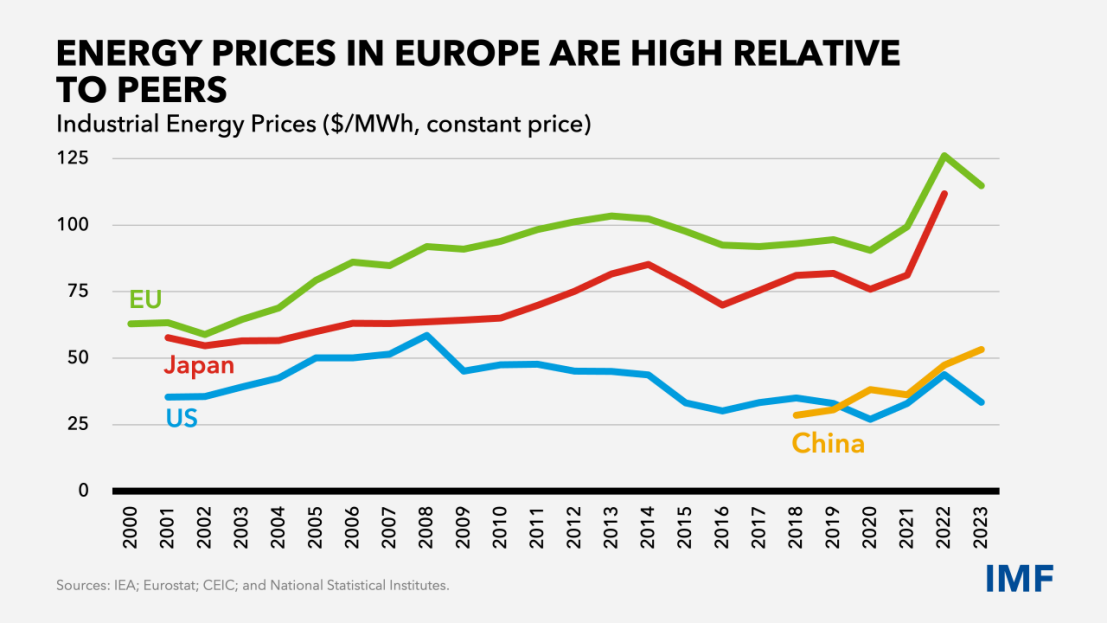
Upcoming IMF research will show that, over the past two decades, the doubling in real terms of EU industrial energy prices has reduced value added in energy-intensive industries by an estimated 18 percent. Lest we forget: energy-intensive industries include game-changing AI.
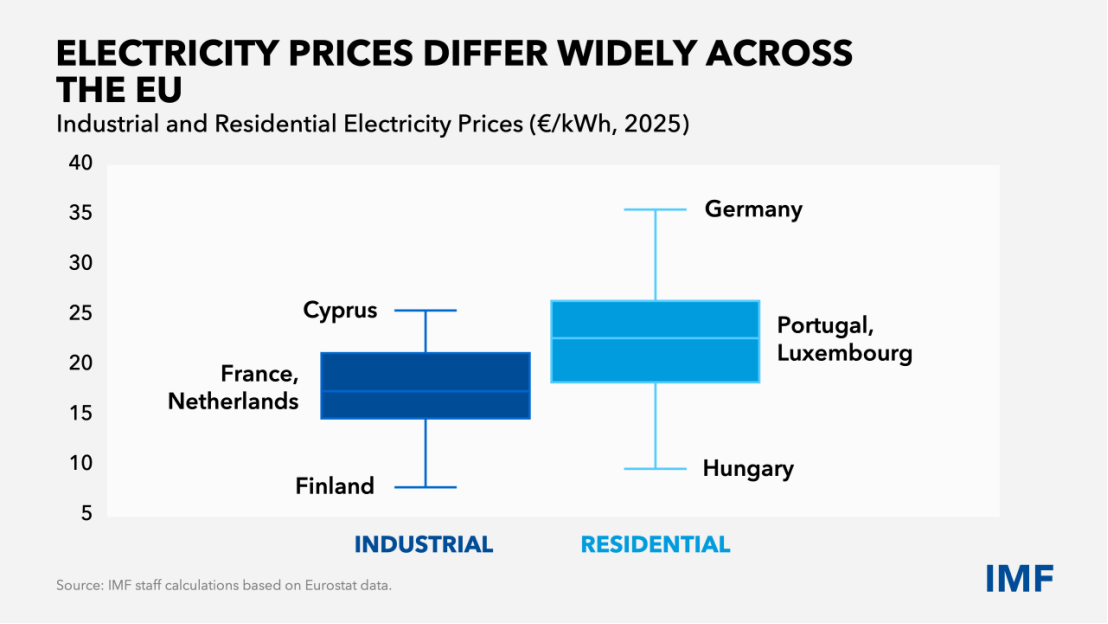
Fact two: Europe’s problem is not only high average energy prices, but volatility and dispersion. Energy price volatility has increased sharply since 2021. And industrial electricity prices in some EU countries are more than three times higher than in others—a startling outcome for a supposedly single market. Both factors hold back investment and productivity.
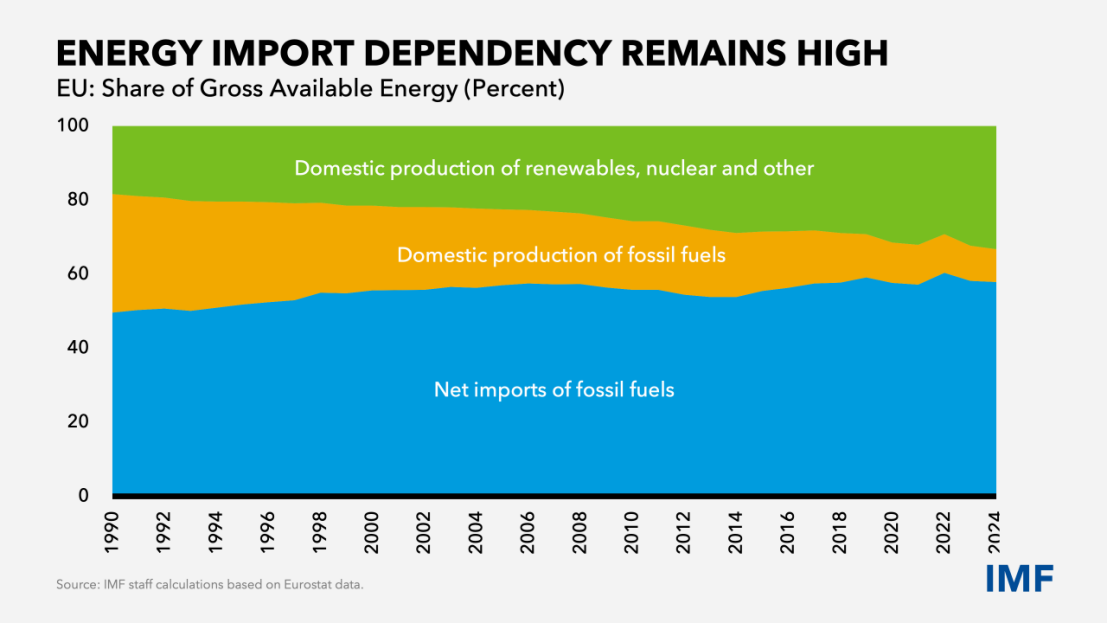
Fact three: vulnerabilities related to fossil fuel imports remain high. Despite all the progress on renewables, the EU continues to import more than 50 percent of its energy needs, a ratio broadly unchanged since 1990 given the trend decline in domestic fossil fuel supply. External supply disruptions still swiftly ripple through to domestic prices and activity, undermining economic security.
It is late in the day, but I do hope that by now some of you may be asking: how best to address these connected challenges?
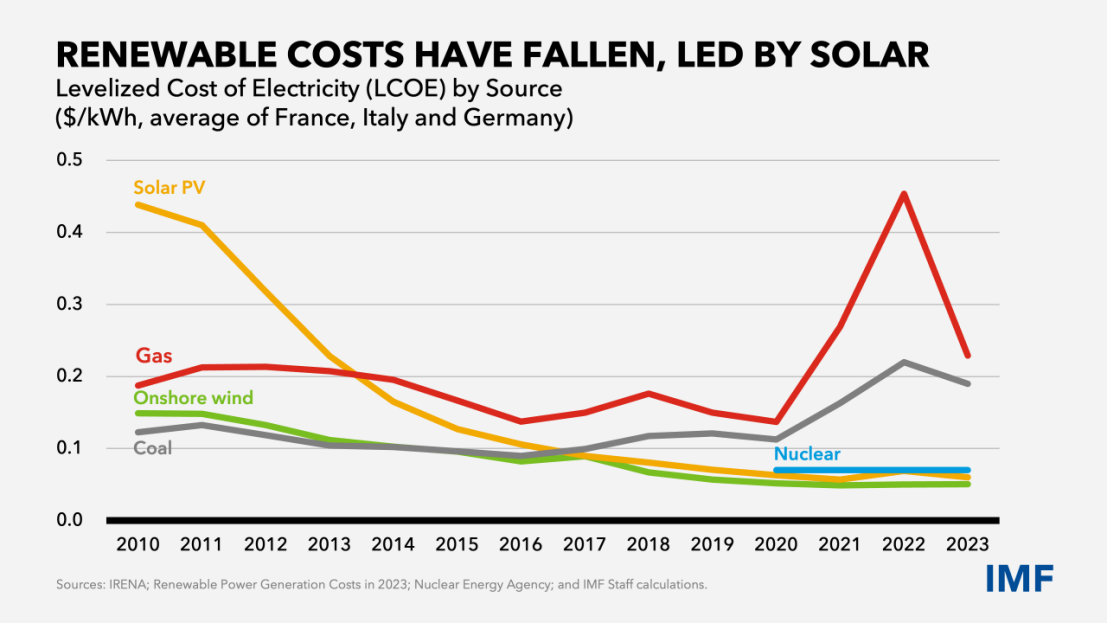
My answer: turbocharge your drive to the energy transition targets you have already set. Accelerate the rollout of renewable energy—which keeps getting cheaper. And pursue two more priorities:
One, better integrate the EU’s internal energy market; and
Two, preserve the right incentives for the private sector, including through the Emissions Trading System.
Integrating Europe’s energy market requires faster expansion of electricity grids and interconnectors, with due deference to technical transmission losses. When electricity cannot flow across borders, local shortages cause local price spikes while cheaper electricity elsewhere goes to waste.
Some worry that with cross-border trade electricity-exporting countries could see higher domestic prices, triggering political backlash. This, in our view, can be addressed by redistributing part of the export revenue back to the public.
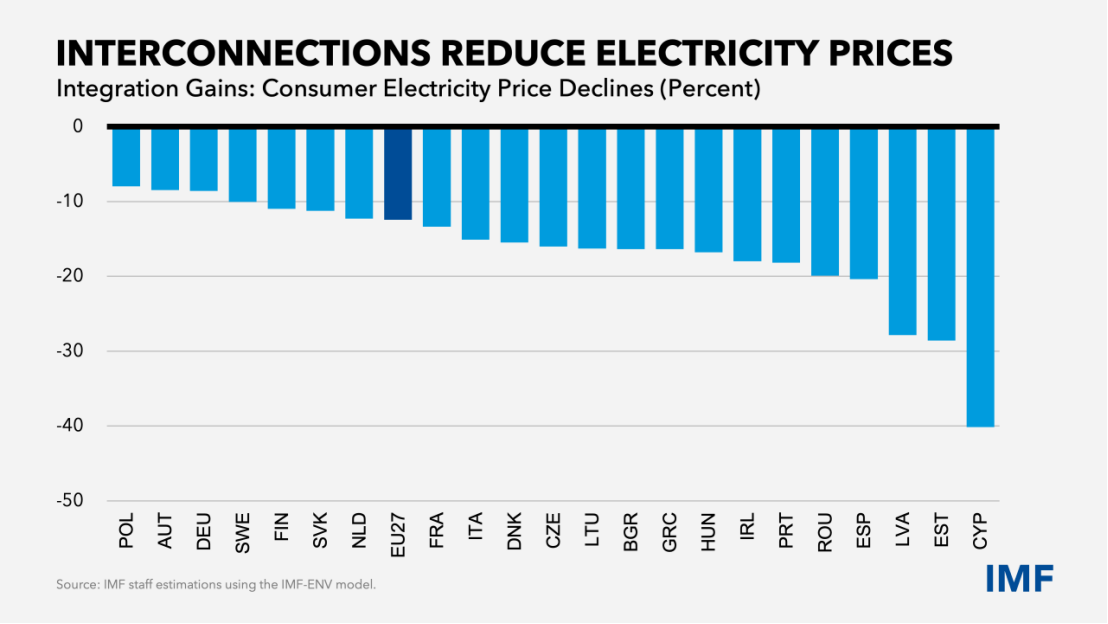
Moreover, forthcoming IMF research will show that in many cases prices have fallen in both the energy-surplus and energy-deficit country after an interconnector is built, because deeper markets allow a more efficient matching of supply and demand over time and location.
Our analysis suggests completing the interconnectors already planned—paired with further expansion of solar, wind, and nuclear—can lower average EU electricity prices by more than 10 percent. The gains are largest where interconnectors relax binding capacity constraints.
We see welcome steps—for instance, the European Commission’s Grids Package; the plan to increase EU funding for the Connecting Europe Facility; and recent efforts to streamline permitting at the EU, national, and local levels. We hope for swift political agreement on all these fronts.
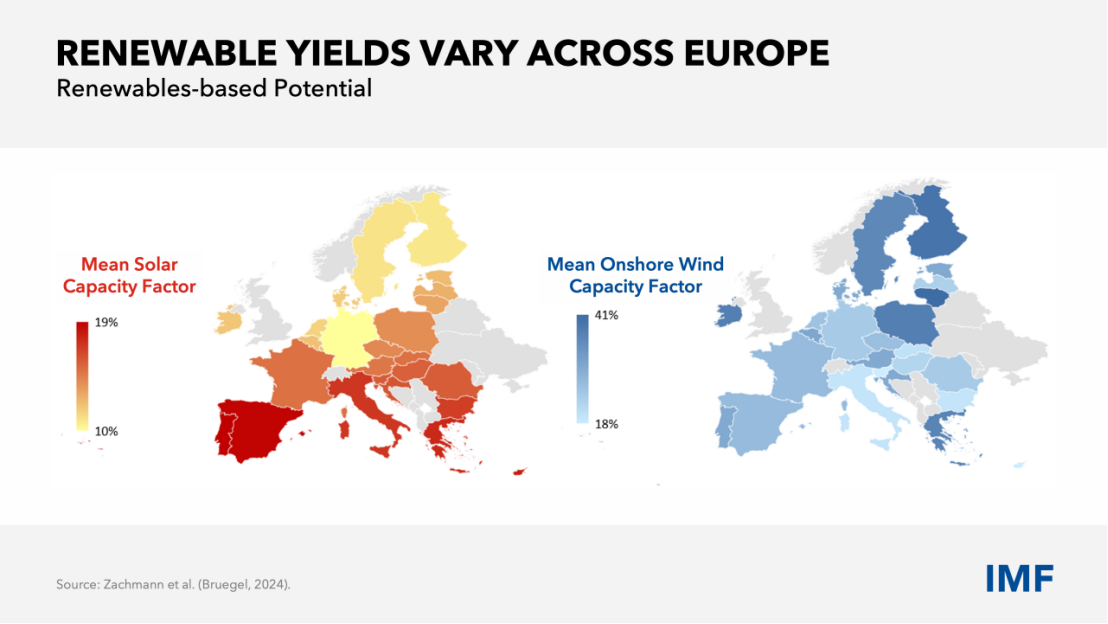
But further progress calls for a more comprehensive approach. A common EU energy blueprint—covering low-cost supply, storage, and interconnections—would help unlock the full benefits of the energy transition. This matters in part because renewables are unevenly spread across Europe—wind in the North, sun in the South—such that purely national approaches to generation, storage, and grids are unquestionably suboptimal.
And let’s not forget that energy union is a key support for a better single market, where there are enormous gains to be had: a 35 percent uplift to per capita income, or more, if Europe can deliver deep reforms at the EU and national levels.
As I flagged early on, let me also stress that private sector incentives delivered through price signals need to be well aligned with the objectives. For this reason, we prefer the Emissions Trading System be protected as a mechanism to spur long-term investment in clean energy—even if it elevates costs in the near term.
In a recent IMF paper we calculated that government revenues from the ETS could eventually amount to about 1 percent of GDP, exceeding the public investment cost of the transition, leaving net fiscal space for other purposes.
More broadly, we find that the EU’s energy transition has few adverse effects on growth, inflation, and the public finances if it employs a suitable blend of carbon pricing and targeted subsidies.
With that key finding, let me conclude, quite simply, by urging you to use the moment. There is that saying, “Never let a crisis go to waste.” I trust that Europe will take heed and act—decisively and as one.
Work with energy ministers, work with Brussels, make energy union a reality.
Thank you.